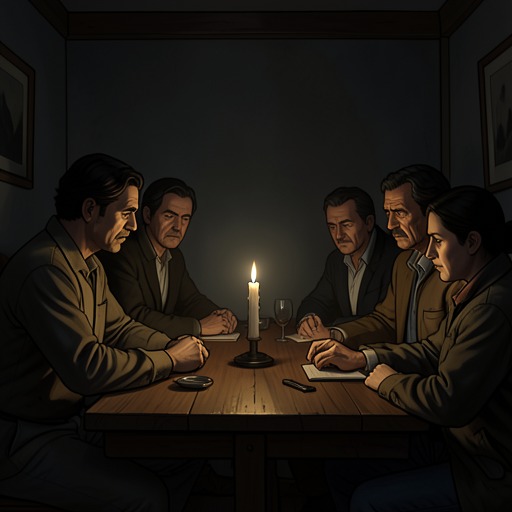
Paul Peace’s death
Killers of the Flower MoonPaul Peace’s death joined a private fear of poisoning to a sudden, unresolved road death. The documents his granddaughter Mary Jo Webb had assembled showed that, in December 1926, Peace suspected his wife of poisoning him and sought help from Comstock, an attorney Webb regarded as one of the few decent white attorneys of the period. Peace wanted a divorce and intended to change his will so his wife would inherit nothing. A witness later testified that Peace had said she was feeding him poison and killing him, but the testimony records his suspicion, not proof of who poisoned him.
Suspicion and Death
Webb had spent decades investigating her grandfather’s suspicious death and brought out boxes of guardian expense reports, probate records, and court testimony when the book’s narrator visited her in Fairfax. On February 23, 1927, weeks after Peace’s stated intention to divorce and disinherit his wife, a hit-and-run injured him and left him bleeding on the road. Webb believed that familiar forces had conspired to paper over his death. The account does not establish who struck Peace or whether the suspected poisoning and the fatal incident were part of the same plot; it presents his death as another case in which the surviving record could not settle what had happened.
A Death Outside the Official Record
Webb described Peace as one of the victims missing from the FBI files, whose killers never went to prison. After recounting the hit-and-run, she urged the narrator to look into the case. The request did not produce a solution: the narrator acknowledged being as lost in the mist as Tom White or Mollie Burkhart. On Webb’s porch at dusk, with the town and street empty and the prairie beyond them, she described the land as saturated with blood, then invoked the words spoken to Cain after Abel’s murder: “The blood cries out from the ground.” The closing image makes Peace’s unresolved death part of a larger history of violence that survived in fragments of family testimony and records, rather than in a settled account of justice.
Poisoning and the Missing Names
Webb’s family account pointed toward a possible source of poison without identifying anyone as responsible for Peace’s death. She recalled that her mother said two brothers who were doctors were widely known as a place where people could obtain drugs to poison Osage people. The account does not establish that these doctors treated Peace or supplied poison to his wife; it preserves a family recollection of a broader route by which poisoning could be enabled. The narrator asked for their names, turning the inquiry toward a specific lead whose answer is not included in the available passage.
What the Record Can Establish
The surviving account keeps three kinds of evidence distinct: Peace’s stated suspicion, the documents and witness testimony preserving it, and the later hit-and-run. Their sequence invites the possibility of a connection, but establishes none; neither the suspected poisoning nor the fatal road incident is attributed to a proven perpetrator. Webb’s investigation therefore preserves a case that can be described in detail without resolving its central question.